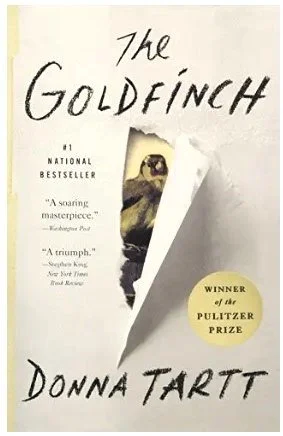
The Goldfinch
About the painting, the book and the magic
We have art in order not to die from the truth. (Nietzsche)
Every now and then, and much rarer as I get older, a book I read throws (disturbs, rattles, unsettles) me in a way I didn’t think possible. This might be because I haven’t read very many great books, or because the book that causes such a reaction is extraordinary. Perhaps it could be both. I’m not sure.
What I am sure of is that Donna Tartt’s The Goldfinch had kept me glued to its 771 pages until my red and blurry eyes scanned the very last sentence. And not only by virtue of “what’s going to happen next,” although there is a great deal of that in the book, more so because of the sheer mastery of the language. The craft of writing. Of weaving not just a story, but a whole world — a breathable, inhabitable world — with words.
And in The Goldfinch, this artistry is fully, if subtly, on display. Just like the painter’s artistry is fully, yet mysteriously, displayed in the painting that lent the book its centuries-old wisdom, and in turn, the book gave it a new life. Neither of which would have happened if they hadn’t found each other, reaching for each other across indefinable times and spaces. Which, in my view, is where the true, even if partially hidden, enquiry of both the book and the painting lies.
The painting came to life in 1654, the same year the man who brought it to life died at the age of 32. Carel Fabritius, born in 1622, was killed in 1654 when a warehouse containing gunpowder exploded in the heart of Delft. His life was taken by a random accident, a meaningless disaster that happened because someone was careless with a match. And yet it is that random, casual cruelty of his death that illuminates his art. The Goldfinch sits on its perch in a Dutch house, chained by the foot, a pet with nowhere to go. While the date of the painting confirms to us that he painted it in the year he was killed, the painter couldn’t have known this as he painted. Or could he? While Fabritius was certainly not the only 17th-century Dutch artist with an eye for obscure, overlooked details of ordinary life, the elusive, enigmatic melancholy of The Goldfinch is both alluring and terrifying.
In the book, first published in 2013, Tartt writes:
There is only a tiny heartbeat, solitude, a bright sunny wall, and a sense of no escape.
Then:
Because — what if that particular goldfinch (and it is very particular) had never been captured or born into captivity, displayed in some household where the painter Fabritius was able to see it? It can never have understood why it was forced to live in such misery; bewildered by noise (as I imagine), distressed by barking dogs, cooking smells, teased by drunkards and children, tethered to fly on the shortest of chains. Yet even a child can see its dignity, a thimble of bravery, all fluff and brittle bone. Not timid, not even hopeless, but steady and holding its place. Refusing to pull back from the world.
The plot, no doubt paying homage to the painting and its creator, focuses on a 13-year-old boy who, in a bomb explosion at the Metropolitan Museum of Art, loses his beloved mother. He comes into possession of the Fabritius painting, which he takes out of the museum, and the dramatic events that follow irrevocably change his life.
Or do they?
Would he be the same boy or man he became if he hadn’t come across the painting or developed a deep, almost otherworldly attachment to it? Or what if he recovered the painting from the carnage, but his mother survived the blast? Or if his unreliable, small-time swindler of a father discovered it? What if he hadn’t met an obscure Russian boy with whom he developed a complex friendship that exposed him to aspects of life he may never otherwise have encountered? Do the random (?) circumstances we find ourselves in shape us and our lives, or do we find ourselves in those circumstances because of who we are? Is there such a thing as fate or even luck?
Surprisingly little has been said or written about Tartt’s exquisite descriptions of the profound grief the main protagonist experiences after the loss of his mother. That is unfortunate. As someone who has been living with deep, bone-shattering grief for over six years, I relate to many of Tartt’s descriptions, especially this one:
Every new event — everything I did for the rest of my life — would only separate us more and more: days she was no longer a part of, an ever-growing distance between us. Every single day for the rest of my life, she would only be further away.
The novel has earned Tartt the Pulitzer Prize, as well as some staunch critics, most of whom, like James Wood, object to the book’s “stagey improbabilities and twists.” Be that as it may, and yes, even I can see why such objections may be invoked by certain critics, the fact remains that Tartt makes readers not only believe all of it but inhabit it. Enter the imagined and re-imagined version of the world and lose yourself in it.
How likely is it for a certain adventure, or even a whole bunch of them, to happen in the real world? As likely as the writer, Donna Tartt in this case, makes you believe. Or as Dickens did, or as many others did and some still do. Which, in my view, is the writer’s true role — to tell the story. To pull the reader(s) in and keep them glued for as long as magic lasts. Not to please, appease, or otherwise mollify anyone, critics, popular trends and fashions included, but to tell the story. As it wants to be told. Let the magic pour from word after word.
I believe Tartt achieved that and more besides.