Freedom of Expression
In a contemporary society
Of all the endlessly and passionately debated subjects across countless media platforms, freedom of expression stubbornly maintains its top position. Paradoxically, the more we insist on debating its meaning and importance, the more controversial it becomes.
Many argue that the right to express oneself freely is the most precious and important thing in life.
I may sound old-fashioned, but it seems to me that the most important thing in life is to have adequate nourishment available to sustain oneself and one’s loved ones. In other words — access to food for ourselves and our families.
Perhaps those who claim freedom of expression to be the most important thing in life have become so accustomed to the availability and abundance of nourishment they no longer notice it, like clean water they drink, warm houses they live in, or the air they breathe.
Be that as it may, those are life’s essentials that should be available to all, and I think most of us would agree that once secured, the right to freely express our thoughts and ideas justifiably claims its position as the next most important thing.
But what does it really mean to us today?
As I write these lines, well-fed and watered, flames of rage are burning in France and many other places across the world, although of various intensities.
Those privileged enough to enjoy high public profiles air their views on these and virtually any subject as much as they like, knowing that their considerable fame and fortunes shield them from the wrath of the outraged, whether justified or not.
The growing number of celebrities, activists, and influencers of all kinds testifies to that. A fair portion of their fame and wealth is generated by the controversies they engage in, which explains the proliferation of media platforms.
The age-old formula of supply and demand remains infallible, as does the creation of a need or crisis for which solutions are then offered. I often wonder how many of the social warriors would remain should their platforms cease to generate profits.
Recently, I came across news about a hugely popular podcast that prides itself on believing in open, fact-based discussions of important and controversial issues. The hosts interview fascinating guests, including prominent political experts, leading economists, psychologists, journalists, and social and cultural commentators.
But they faced a real threat when their bank notified them of the impending closure of their accounts without providing any further details, including the reasons for such drastic action.
By no means are they the only ones in this position, as other similar platforms have suffered the same fate. In all cases, attempts to obtain an explanation from banking officials have proven futile, with standard responses assuring them that “the bank is looking into the matter” and will inform them of the outcome “as soon as possible.”
However, the popularity of those platforms meant they were able to whip up considerable commotion and elevate their plight. Meanwhile, one can’t blame the platforms’ creators for suspecting that their bank(s) actions are motivated by the content they produce and air.
Or to put it another way — powerful corporations have taken it upon themselves to police the public square and penalize those they deem undesirable. This is an unfortunate but not uncommon phenomenon in our time, reminiscent of Canadian trackers and their bank accounts.
I do not doubt that the smart individuals behind the popular podcast and similar platforms will use these events to further promote their platforms, delighting many and drawing scorn from others. It is how free speech and other forms of free creative expression are meant to work — by letting the audience decide.
But what about the rest of us, the ordinary citizens without access to powerful media machinery or the leverage of fame and money?
How do we deal with the long arm of censorship? Should we simply shrug our shoulders, resigned to the wisdom of our predecessors that some will always be freer than others?
Having lived for over five decades and in various places, I’ve witnessed several instances where allegations, ranging from accusations to charges, have had catastrophic consequences for those targeted, even if eventually dropped.
Not too long ago, I witnessed a case where vaguely defined allegations of “offensive comments,” which were later dropped, cost a person their lucrative career and almost a twenty-year marriage. By the time the lengthy process resulted in the dropping of charges, the person in question and everyone involved felt the chilling effects of an intimidating procedure intended to stifle free speech.
Well-intentioned friends and observers advised the unfortunate individual to “keep your mouth shut in the future… it isn’t worth it mate!” The insidious nature of self-censorship was working its way into the collective consciousness.
While it is clear that any openly threatening or abusive speech must be swiftly and adequately addressed, the problem with outlawing insults is that almost anything can be interpreted as one.
Criticism can easily be construed as an insult, as can ridicule, sarcasm, or expressing an alternative point of view to the prevailing orthodoxy. Since these things can be interpreted as insults, they frequently are. Furthermore, the offended party only needs to demonstrate that their feelings were hurt as a result of what they found insulting.
It is perhaps indicative of the times we live in that attempts to contain the more obnoxious elements of society are resulting in the creation of an authoritarian and controlling society reminiscent of the totalitarian regimes of the 20th century.
Some have referred to this intense desire to silence uncomfortable voices of dissent as the “new intolerance.” It is not rare to hear well-educated and liberal-minded individuals, neatly attired and softly spoken, proudly proclaim that they are “only intolerant of intolerance.” Suggesting that this belief means replacing one form of intolerance with another is met with hostility. At this point, one can only rest one’s case.
A few weeks ago, a 13-year-old pupil of a UK school was called, by a teacher and in front of a whole class, despicable, told that, “I am reporting you to … (school principal) because you need to get a proper education and conversation about equality, diversity, and inclusion,” and finally told that, “if you don’t like it, you need to go to a different school” — all because the pupil dared to question the notion that people could identify as whatever they wanted, including as cats. The audio clip of the teacher-pupil exchange, including the pupil’s comment that most of the students agree with me but are too scared to say anything, had gone viral, so you might have seen it.
Irrespective of whether I (or you) agree with one or the other (or neither) side of this, or any other similar debate, the point is that all the views, provided civilly delivered, have the right to be heard.
Whether Voltaire himself or, as some believe, his biographer coined the phrase — “I disapprove of what you say, but I will defend to the death your right to say it,” the fact remains that centuries have gone by and we are still struggling to grasp the meaning and the importance of it.
Underlying prejudices, injustices, or resentments are not addressed by penalizing, silencing or excluding people. On the contrary, they are addressed by airing, arguing, and freely discussing the issues, preferably outside of the legal system and the coercive powers of the state (or school).
The best way to increase society’s resilience to insulting or offensive speech is not to ban it but to hear it. Just like with germs, we can better resist those to which we have been exposed. Exposure, not prevention, builds immunity.
We need to develop our immunity to taking offence so that we can address the issues that criticism can raise. Our priority should be to deal with the message, not the messenger. Efforts to restrict speech can, and often have, become tools to silence critics or anyone with different views.
If we want robust societies, we need robust dialogues, and that must include the right to insult or offend. Whoever said that “the freedom to be inoffensive is no freedom at all” understood the true nature of authoritarianism perfectly.
Halting what one famous writer called the “Outrage Industry,” fuelled by self-appointed arbiters of the public good who actively encourage media-stoked outrage, is the necessary first step. This industry, more often than not, ends with the question, “What are you going to do about it?” directed at the police or some other authoritative agency.
Just like any industry, the “Outrage Industry” depends on its ability to attract and retain revenue-generating consumers, the real motivator behind many of the self-appointed do-gooders and their supporters.
The most powerful weapon against offensive speech is not repression but freedom, which includes free access to meaningful resources necessary for raising resilient free-thinkers and ethical entrepreneurs. This means quality education, housing, food, and healthcare — in a word, a better quality of life for all.
It is where the roots of the violent protests really lie.
When a 17-year-old unlicensed driver is shot by a police officer whose subsequent attempts to cover up his action were revealed thanks to a video shot by a member of the public — the riots that ensued demonstrate not only the immediate outrage but deeply seated and long-standing discontent.
Sadly, and as seen in similar situations elsewhere, the all-over violence and looting that followed serve two main purposes (whether intended or not); obscuring the real reason the protests started (senseless killing of a young man and cowardly attempt to conceal it) and increase in state brutality justified as a necessary measure against large-scale distractions and stealing.
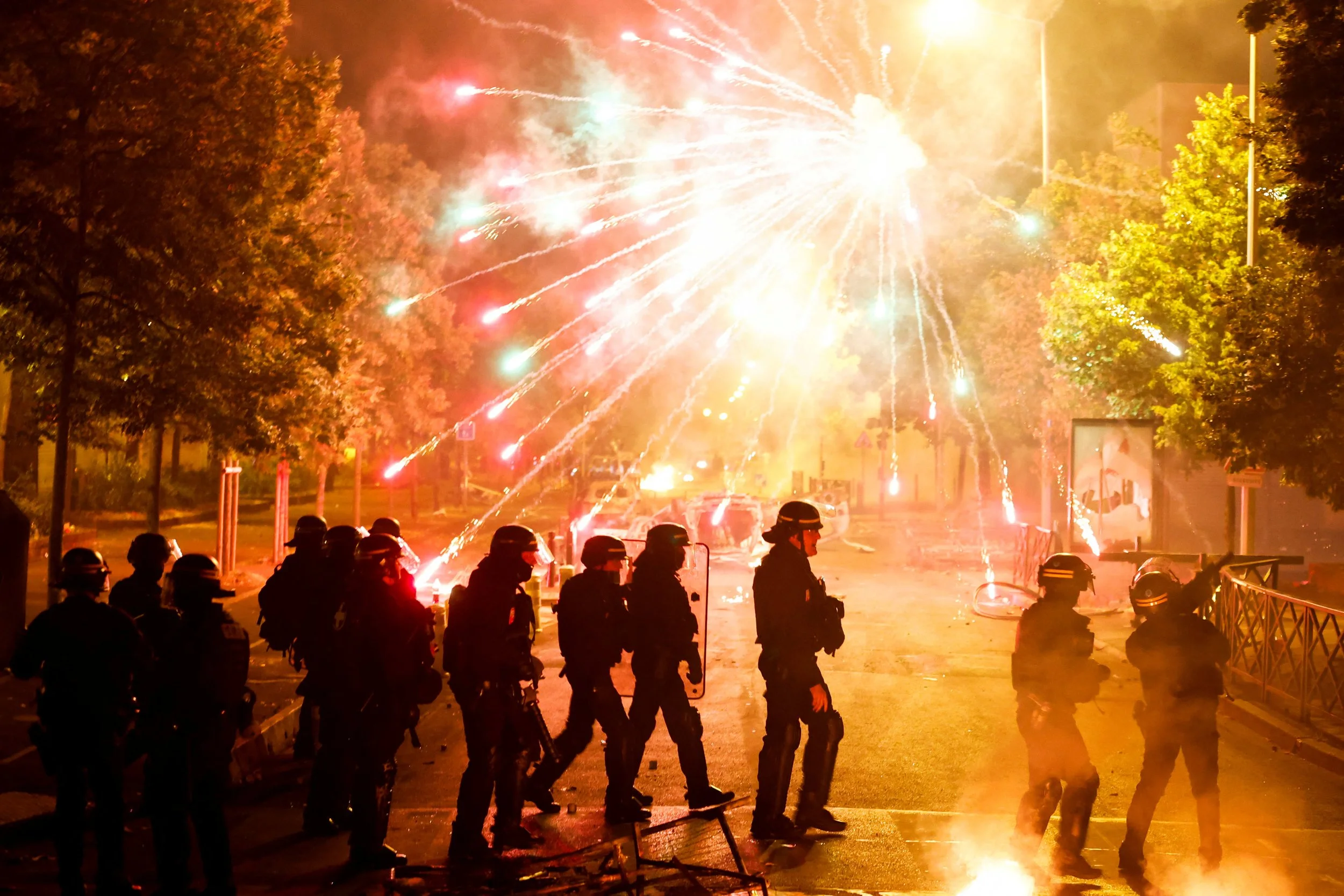
In tear-gas fog and cacophony of voices, the tragedy and reasons for it will be first obscured, and eventually forgotten. All as the media trenches are bursting with serving their two main purposes; providing the outlet for the masses to discharge their (variously packaged) outrages while feeling good for having “done something,” and generating huge profits for the platforms’ owners.
When a 30-year-old Iraqi refugee obtained official permission to hold a one-man protest that consisted of burning, stomping on, covering in stripes of bacon and otherwise desecrating the Quran in front of the biggest mosque in Sweden and on one of the holiest days in the Islamic calendar, the official response to the outrage that followed was swift.
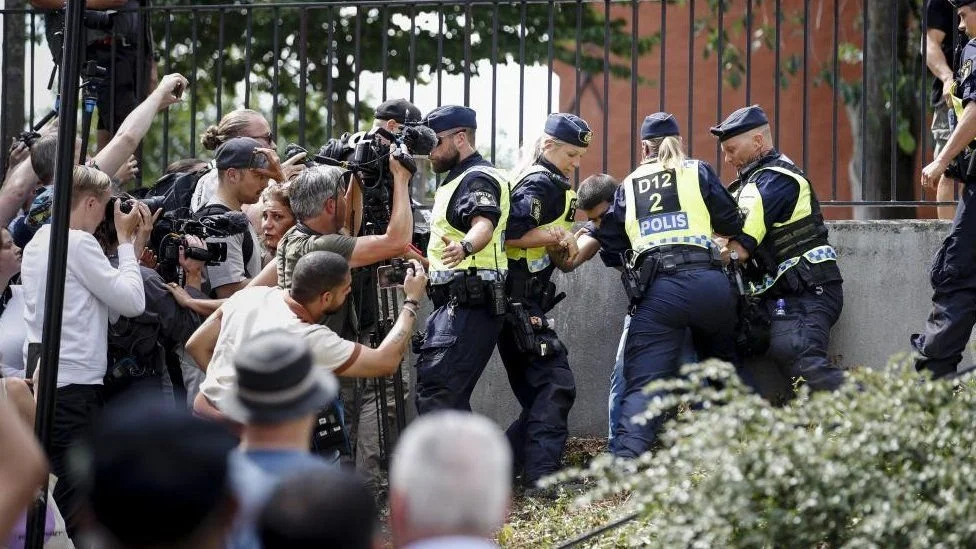
By the same officials that granted the permission for the performance to start with and in a country known for similar incidents that is presently trying to join NATO.
Unsurprisingly, the reaction from the biggest opponents to those efforts, Turkey, came in a matter of minutes. Also unsurprisingly, media trenches burned with outrage and speculations of all kinds, serving the same two purposes as ever — providing a vent and generating profit.
No more does the desecration of a holy book of any denomination represent freedom of expression than does the burning of buildings or looting of shops.
They are acts of violence committed to benefit their agendas while using legitimate crises as shields.
The unnamed police officer in France did not fall on his sword after shooting the unfortunate youth — instead, he tried to cover up his crime.
The Iraqi man proclaiming to protest for Quran to be banned in Sweden did not stand in a public square and shout about it — instead, he undertook actions designed to desecrate the book millions hold as holy.
But for those actions to be seen for what they are, and the real issues addressed appropriately and meaningfully — the aforementioned resilient free-thinkers and ethical entrepreneurs raised and nurtured in societies with adequate housing, accessible, quality education, employment and healthcare are required.
Such circumstances would likely render the endless proliferation of dubious media platforms and their often toxic content redundant. But then … what would that do to the mighty profit!
This is not to suggest that the media is the main culprit, as the French president seems to suggest, only to point out that a society build on those values (however utopian that might sound) would be a natural buffer against the evils of racism and similar abominations.
Instead of showing a disregard for the seriousness of the situation by attending a popular concert as riots erupted and continuing to deny accusations of racism and racial profiling within French police, all of which are likely to deepen already deep social division, the French president and others in charge, would likely help their country far more by seeing the things for what they are. It was indeed in France that both; wealth and power, proved to provide only limited protection to those who, not all the long ago, made similar mistakes.
A German with a funny moustache, whose name remains a symbol of evil, would have likely forever remained a frustrated watercolourist if it weren’t for the support of his outraged countrymen, many of them impoverished industrialists. The early attempts to ban his frenzied speeches were counterproductive — they attracted more audience and fell on the fertile ground of discontent fuelled by a sense of injustice and unfair treatment resulting from the Treaty of Versailles.
While it would be speculative to assert that even if the funny-moustached man’s early speeches had been banned successfully, the combination of other factors — mainly economic conditions, and societal discontent, would have inevitably led to the same outcome, it is not too far- fetched to assert that without those conditions, his oratory skills, however powerful, would unlikely gather the support they did or have the impact they had.