How I did (not) become a writer
An unlikely journey
A long time ago a famous American writer, whose name eventually got me in a sort of pickle, proclaimed that:
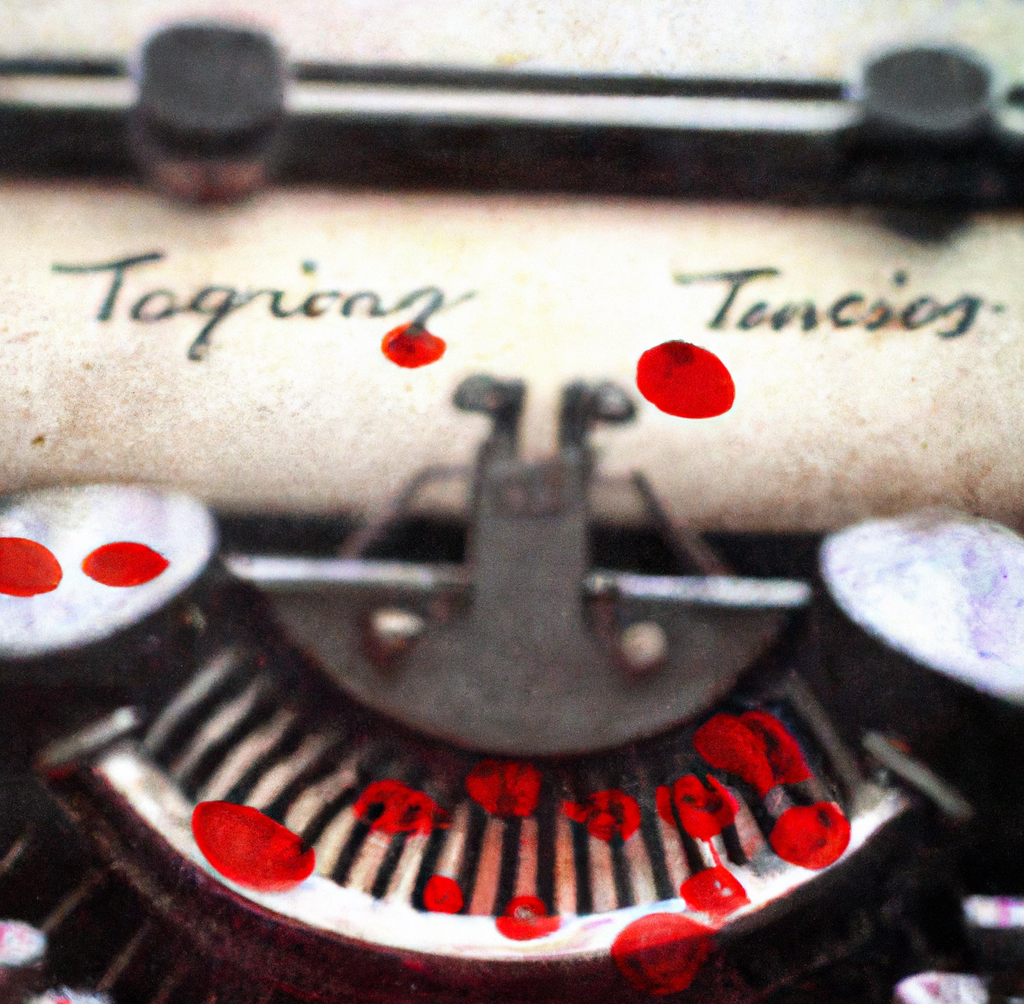
“There is nothing to writing. All you do is sit down at a typewriter and bleed.”
Indeed.
Since the time I first discovered the quote, I came to appreciate it more with each passing year. If the promised outwardly realms exist, I have a good mind to find the said fellow and have a few (or more) words with him in a free and frank fashion. I admit to having a rather long list of similar fellows I am to look for over there across the great blue yonder, but this mighty fellow features in it too.
To start with I’d like to know when and where one actually starts bleeding and what colour the said liquid ought to be. For, over the years, I have noticed that some bleed a pale, insipid liquid of no colour, scent or texture, they bleed for bleeding’s sake, to show they too are in possession of the fluid. On the other hand, some bleed thick, crimson liquid, of either rancid or sweet aroma, and textures so prominent that it is a wonder the mighty substance passes through their veins to begin with. Yet others do not bleed at all, they watch others do, take notes and write opinions, critiques, and observations about it.
Even though it could never be verified, I think I first started bleeding as a small kid while narrating a story to my grandparents and insisting it all happened exactly as I said. When my grandfather pointed out that, owing to sheer timing, the events could not have happened as I claimed — I burst into tears. My grandfather, a large man with eyes as green as river-stones, winked at my grandmother and said — “this one is a storyteller.” I wasn’t quite sure what to make of it, but it seemed to me an improvement in status, so I settled into his lap, amongst hair-thin strands of golden tobacco and watched him roll a cigarette, a task his thick fingers were incredibly swift at.
Later on, when school became a daily routine and we were required to read and write about a set number of books each week, I delighted at the task and started penning my own poems and stories. Every now and then a teacher would compliment my work and sometimes even ask me to read what I have written in front of the class. I trotted to the assigned spot next to her desk and read my words as quickly as possible. By the time I finished, and the class, following the teacher’s lead, started clapping, I was obliged to grasp the edges of my classmates’ desks so as not to faint before reaching my own desk. Fainting was my specialty back then.
By virtue of those practices, I arrived at the first year of high-school more or less convinced that I could write some good lines. By sheer chance and communists’ zeal for reformation, I ended up in a high school that was, prior to reformation zeal, a highly regarded gymnasium and, at the time of my arrival, still held on to its former academic exclusiveness.
Our language teacher turned out to be a young woman with a willowy figure and large, moist eyes. She wore soft pastel colours and subtle makeup. Her voice was gentle and her sentences well-formed. I thought her very smart.
At the end of our first class, she tasked us with writing a piece of prose or poetry and be prepared to share it with the class. I could not wait to come home to start writing. I could see the words forming in my mind like tiny specks of light. That night I wrote a prose poem after the fashion of poets I adored at the time, Yesenin, Lorca, Neruda, Ujević, Antić. On the top of the first page of my new notebook in bright blue ink the title The Wedding proudly stood above the lines bursting with street musicians, barefoot gypsies, horses as dark as night and the inevitable knife between the ribs.
I was glad when my turn came to read it. I all but volunteered for it.
After the first few lines, I sensed a commotion. I stopped reading and looked up. The subtly made-up eyes of the teacher were sparkling with laughter. From the corner of my eye, I could see smiles on the faces of my classmates. A short boy with freckles turned his grinning face towards me. The heat rose under my breastbone then travelled upwards to my cheeks. I returned to reading. The laughter intensified after each line, as my face burned with fire. In its glow, I could hear the distant cry of a violin, the melody of a song the bride sang, her long dark curls cascading down her back, over the rich embroidery of her wedding dress. I gasped for breath and clenched my fingers tighter over the page. My voice rose above the laughter, I continued reading. There was silence again. I read the last verse. The laughter erupted stronger than before. The teacher was no longer attempting to hide her mirth inside her hand. I was standing with my notebook open as the class was laughing. Large, hot tears rushed down my face. Like a waterfall. Unstoppable.
The year was 1980 and I was 15 years old.
I did not write another word for almost 30 years.
In 2009, in another country and another language, owing to curiosity more than desire, I found myself in a creative writing class held by an American teacher. She too wore subtle make-up, but it was the only subtle thing about her. The class was to write a piece on “any subject that comes to mind.” I penned a story, Grandmother. The first story I wrote in English. I was 44 years old.
The American teacher returned the next week with a stack of our work marked and with comments written in the margins. As she handed the pieces to their respective writers she commented on how “there is a writer in our midst.” I doodled tiny houses as I always do when idle. Then she said my name. First, I looked up. She wasn’t laughing. Then I looked behind me. To make sure doors were still there. Because I chose my seat by its proximity to the exit. They were. I left at the break.
But I did come back the next week. And wrote more stories and an occasional poem. It was a slow, painful process. It still is. To say not what one can, but what one wants. In English.
I continued to write and, occasionally, submitted some pieces for publishing.
Two months before I lost my daughter, my first story was published in an Australian magazine.
The night before the terrible news arrived, I was standing on a small podium in a local bookshop attempting to read one of my poems. As soon as I reached the line, … when my daughter returned … a bolt of pain shot through me, and tears poured down my face. I left the podium, trying to apologise. On my way home, I became disorientated and lost my way. On the streets, I have known for years.
It was the second time in my life I attempted to read something I wrote to a live audience. Both attempts ended in tears.
Three years later my place of employment where I had worked diligently for almost 20 years decided that I am rather too deranged to continue. One of the reasons they cited was a short story of mine that one of the local papers published, an act I was, apparently, obliged to disclose to my employer, but failed to do so. I almost laughed.
Let loose and with nothing to do and nowhere to go — I enrolled into a creative writing course where, I was told, only the best make the cut. Very well, I thought, I’ve nothing left to lose in any case. But I did make the cut and was duly admitted amongst the chosen. At the introductory class I made a grave error. I cited Hemingway, you know writing and bleeding and all that crap. In the next class a young lady with promising literary prospects declared that she is, “never going to be a wanker-writer who cites Hemingway.” This time I did laugh. To tears.
Then I went home, poured myself a drink, lit a fag and wrote…and wrote. Polishing words like my grandfather polished his Luger, until the shine of it felt warm in the palm. It gleamed.
I was never invited into the so called inner circles, but I arrived at the end of the course with a manuscript of 130,000 words. Polished, primed, and ready. Those tasked with appraisals of such things said it was good, even very good, distinct. Only too risky to be published. In this country. Sensitive readers and other assorted vigilantes might have a bit of a problem with it.
Last week I spoke with two agents from one of the UK’s largest agencies. Nothing is of course certain or confirmed. Maybe only a little bit hopeful.
So, this is how I did (not) become a writer.
True, any, and I mean ANY sensible, heck, even just sane person would surely give up long before now.
I would too.
If I am either sensible or sane.
But I am neither.
Because I am (not) a writer.
Bleeding till the last drop.